Feeds:
Posts
Comments

Dear Devotees,

We hope you are doing well and
could enjoy the warm weather so far. We welcome you this weekend with the great
opportunity to join Harinam on 5th Nov , Saturday and Sunday feast on 6th Nov,
at regular timings. Please see the details below – 

Saturday Harinam on 5th November:

Timing 1300h – 1500h ( please
see attached poster for more details)

Note: if you are coming and staying for
prasad, please confirm to us by sinding an email to harinama.belgium@gmail.com


Sunday feast on 6th November:

Timing 1330h – 1630h 

Topic – Growing towards Krsna: how
gradual is the process of bhakti supposed to be, reflections on surrender

Speaker – His Grace Janmastami Prabhu

Sunday feast would be also live
on Facebook –

https://www.facebook.com/BrusselsBhaktiYogaCentre/live_videos/

Your servants @,
Brussels Bhakti Yoga Center
Oudergemlaan 197

Dear devotees,

Please do not forget that this weekend, we change the clock to wintertime.

Sunday morning 3 o’clock will be then 2 o’clock… 1 hour more japatime 🙂

Have a nice weekend

Your servants @,
Brussels Bhakti Yoga Center
Oudergemlaan 197 

Dear Devotees,

Hope you are doing well.

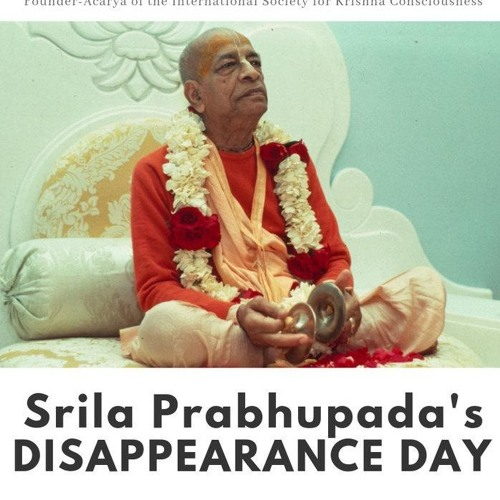
As announced earlier, we are pleased to invite you to the festival of Srila Prabhupada’s (founder Acarya of ISKCON) disappearance day.

As this will be remembering Srila Prabhupada and his mission, please feel free to share his pastimes(katha) which inspire you the most.

Following is the agenda –

1330h – bhajans
1400h – Srila Prabhupada katha/remembrance by various devotees
1530h – Prasadam meal

To join online:

Please note that there will also be a Facebook live for this event –

https://www.facebook.com/BrusselsBhaktiYogaC…/live_videos/

Your servants @,
Brussels Bhakti Yoga Center
Oudergemlaan 197 

Hare Krishna Dear Devotees,

As tomorrow is the day of the festival of Govardhan Puja, we are glad to invite you for some solid kirtan and some prasad again :

tomorrow Wednesday 18-20 h : Kirtan (followed by some prasad)

Please note also that on Sunday we will commemorate Srila Prabhupada’s disappearance (just so a maximum number of us van join together, which is not so easy during the week)

Your servants at the Bhakti Center

Hare Krishna Dear Devotees,

As we are approaching the festival of Govardhan Puja, we are glad to welcome you again this Sunday to hear Govardhan katha along with some bhajans. Below you will found more details –

Agenda:

1330h – kirtan

1430h – Govardhan katha + bhajans

1600h – Prasadam meal

Please come and take part in the nectarean flow of the holy names. 

To join online:

Please note that there will also be a Facebook live for this event –

https://www.facebook.com/BrusselsBhaktiYogaCentre/live_videos/

Your servants @,
Brussels Bhakti Yoga Center
Oudergemlaan 197

IMG_3904-200x200

Extract from a lecture given by HH Lokanath Swami:

“One devotee was explaining when I was a bhakta, I remember this example from that time, he was Achyutananda Swami. He said, “Okay, take off in an airplane at noon time and then let your plane fly the westward direction with a speed of, say, a thousand miles per hour approximately – what would be the experience?” The sun would be just above the head, above that aircraft, because the earth is also making circles around its axis and its circumference is some 25,000 miles around. So your plane is going approximately a thousand miles per hour, so if you take off at midday, wherever you go, the sun would be just above there, so what? Then the remaining example or the explanation is that if we are always chanting Hare Krishna, then Krishna who is like a sun – chanting Hare Krishna or studying Bhagavatam or honoring prasadam or taking darshanam of beautiful Radha Madan Mohan, engaged in devotional service of the Lord – then the sun will be always shining upon you. The Lord will act as a sun and you will never ever be in darkness. Like that person flying in the aircraft, he always will be on the light side, never on the other side, the dark side.”

image

An extract from a lecture given by HH Lokanath Swami:

“Yesterday some devotee was comparing kirtan to japa saying that, “Japa is monotonous; same thing goes over and over again, one may have disinterest. It may be mechanical etc”. …

If your mind is going elsewhere then you have another exercise to do… Drag it back, bring it back. Take the help of intelligence. Who is superior to the mind? Intelligence is superior to the mind. So where is mind going, whether it is going to the right place or wrong place or is it timely for the mind to go… Who will decide all this? Intelligence decides. Power of discrimination is with intelligence. Mind doesn’t have its own philosophy. Mind is just floating. Just like child. While walking, passing by the shop, the child cries… daddy, daddy… I want that. Mind is like that. Daddy tries to convince… no no… Take this lollipop and then the child runs for that. Just a moment ago the child was crying for something else and now drops that and runs for something else and then something else. There is nothing fixed about the mind. Hence you could change the mind. Mind you could change. Train the mind. Shape up the mind. So there is a scope. Knowing that there is scope for changing the mind, it is possible to changing the habits of mind. Mind doesn’t have its own philosophy. Superior to mind is intelligence. …

We have to have intelligence and exercise it, use that intelligence for improving our chanting. So you prove you that you are intelligent by using the intelligence. So your two hours, the 16 rounds – this is the time for you to use intelligence. Otherwise it is just sleeping business because intelligence is not being exercised. If intelligence is at job, alert sharp intelligence, immediately you will be able to tell: oh you are sleeping, you are doing this, your mind is going away … you will watch and point out and come up with rectification measure.”

If you want to read more on this topic please visit the Lokanath Swami’s Chant for Change initiative.


zz1120brahmanda

Everyone is now talking about crises: financial, economic, social and the like. But few realize that behind all these, there is a much more devastating crisis that is the cause of all the others. Its effects are so great that absolutely all living entities in the universe are affected by it. This is called the housing crisis of the soul.

As far as the Vedic worldview is concerned, we have left our real home. Instead of living with God or Krishna in the center of the spiritual world, where all our comfort is automatically ensured for eternity we have chosen to live in the ghetto, also known as the Material World. Down here we live on our own, we have to pay bills and a huge rent. Also, we have to change our residence—the body—after every lifetime.

How did we end up like this?

While living in the spiritual world, a minority of souls have the desire to imitate Krishna and to act as if they are the Lord. In that instant there is a conflict of interests because only God can be God. Only He is able to wield His own power, which would bewilder any other entity. So it appears that these souls now have a problem—they want to be the ones who makes things happen, independently, but they can’t actually do it in God’s presence, since God’s energy only listens to Him.

In this context, Krishna, in His divine mercy, creates an educational program called mayā, especially designed for these rebel souls. This process is an inconceivably sophisticated simulation of the spiritual world, in which the souls willing to act as lords can live as if they are separated from Krishna and can experience life without Him. To our modern understanding, this program is similar to a highly complex 3D computer game. A gamer becomes so absorbed in being the character in the game, lost as they are in the countless experiences offered by the game world, that they lose contact with reality. Just as the player gradually accepts the world of the game as their day to day reality, so do the souls accept the material simulation as their natural home.

Now what? Although captive in this world, our existential anxiety—on which rivers of literature have been written—makes us realize that something is wrong with the world. In our rare moments of peace we experience this anxiety—the soul’s “housing crisis”. What am I doing in this corporeal existence? I am not made to suffer. I have a body that is degradable, I have to make a huge struggle for the slightest comfort, I am always in tense relationship with the others, I am subjected to natural catastrophes, violence and all other calamities. This is not right. Why do I not accept these things as natural? Why do I have the feeling that there is more to all of this?  And then we begin to look for the road back to our native home.

This is where Krishna’s appearances in this world come in, such as that of 5000 years ago when He came and spoke the Bhagavad Gita. He comes and reminds us of our home, where He is waiting for us to live happily with Him. The only thing we have to do is to really want to return, and then He will teach us step by step how to actually achieve it. The shortest route Krishna presents to us in the Bhagavad Gita is bhakti yoga: the path of devotion. Through the active engagement in the divine service, any soul now lost in the ghettos of mayā will come back home, where God or Krishna will have been waiting for millions and millions of years.

The Scent of the Soul

reincarnation1

The Vedic theory of reincarnation holds that the divine arrangement enables us to live multiple lives in the context of a long-term educational process. But since we can’t seem to remember anything from our previous existences, someone could ask how we are supposed to learn something from them. This question can be answered with the help of a pot of boiling water, a poem and a scented flower.

We are all very careful when we are carrying a pot of boiling water. Even if no drop is touching our skin, the very anticipation of this danger makes us tread lightly. The question is: when did we learn that we need to stay away from boiling water? What was the exact context? How old were we, in what location, what clothes did we have on? What was the weather like? Hard to say. But, still, this act of learning had to have happened sometime during our lifetime. Although we’ve forgotten the details, we have not forgotten the lesson: careful with boiling water.

Let’s take another example. Escaping the cold outside, relaxing under a warm blanket, we read something nice – say a lofty Rudyard Kipling poem. Carried away by the awe inspiring images, we let ourselves be seduced by the poet’s talent. All this time, our mind is silently accessing and processing hundreds of grammatical rules and word meanings. Can we remember the details of the context in which we have learned each and every rule? Definitely not. But still, the assimilation of the essence of those learning experiences is evident by our ability to read and enjoy the poem.

But even if we could remember, would it really help us? On the contrary. Let’s imagine that while we are savoring the subtleties of the poem our mind would suddenly be invaded with specific memories associated with the learning of every word and every grammar rule inherent in the processing of those verses. Could we then be able to concentrate on the poem?

This cumulative learning mechanism, through the assimilation of the essence and the discarding of the context details also applies to the lessons we have learned from previous lives. The arrangement of nature makes it in such a way that the soul is able to carry with it in a mind-bottle technically called citta the essential teachings of the previous life reflected in our worldview, habits and behaviors, but it spares us the mental overload which would paralyze our life if every time we were about to do something, we would automatically remember every little detail about that something.

In the Bhagavad Gita (15.8), the Supreme explains this using a comparison: the living entities in the material world carry with them various conceptions of life from one body to the next, like air currents carry with them a variety of scents from the flowers. Elegantly put.

In conclusion, despite our forgetfulness of our previous lives, the essential information is there, somewhere in our mind, present in the form of so-called inborn tendencies, traits and inclinations. The lessons are there at our disposal. The important thing is to use them wisely in order to be successful at our Final Exam.

Для того, кто желает обрести счастье и освободиться от всех страданий и тревог, медитация представляет очень важный аспект деятельности.

Медитация означает «мысленное созерцание», но ведь у созерцания должен быть объект. И чтобы избавиться от повседневных тревог, занимающих ум, человек должен подняться над материальным уровнем и попытаться утвердиться на трансцендентном, духовном уровне. Сделать это можно, если постоянно повторять имена Господа, таким образом общаясь с Ним.

Как утверждается в различных писаниях, у Господа много имен: Кришна, Рама, Иегова, Аллах, Будда и др. Повторение имен Господа, Мантра медитация, оказывает очищающее воздействие и позволяет человеку подняться с материального уровня на духовный. В Индии на протяжении тысячелетий люди повторяют имена Господа в виде мантр. На санскрите Мана означает «ум», а трая — «освобождение». Таким образом, мантра — это комбинация трансцендентных звуков, освобождающая наш ум от тревог.

В ведических писаниях приводится мантра, которую называют Маха-мантрой, т.е. великой мантрой. В «Кали-сантарана-упанишаде» говорится, что шестнадцать слов, составляющих ее — Харе Кришна, Харе Кришна, Кришна Кришна, Харе Харе / Харе Рама, Харе Рама, Рама Рама, Харе Харе, — особенно рекомендуется повторять в Кали-югу, наш век раздоров, тревог и лицемерия.
Кришна означает «всепривлекающий», Рама — «всерадующий», а Харе — это обращение к энергии преданного служения Господу. Таким образом, Маха-мантра означает: «О Всепривлекающий, о Всерадующий Господь, о духовная энергия Господа! Прошу, позволь мне преданно служить Тебе».

Для медитации, чтения Маха-мантры Харе Кришна не существует строгих правил. Самое замечательное в мантра-медитации то, что ею можно заниматься где угодно и в любое время — дома, на море или, когда вы едете, скажем, в автобусе или на метро.

Существует два вида мантра-медитации: индивидуальная, при которой человек читает мантру на четках (это называется джапой), и когда он повторяет ее вслед за кем-то (это называется киртаном). Киртан обычно сопровождается игрой на музыкальных инструментах и хлопанием в ладоши. Рекомендуется и та и другая форма мантра-медитации, так как обе они благотворно влияют на человека.

Джапа медитация

Для этого вида мантра-медитации нужны лишь круговые четки. Их можно купить в магазине или сделать самим, следуя приведенным ниже простым рекомендациям:
Купите 109 больших круглых деревянных бусин (если нет деревянных, на первое время возьмите любые другие) диаметром от одного до двух сантиметров с отверстиями, чтобы можно было нанизать их на нить, а также от трех до пяти метров крепкой нейлоновой нити.
Отступите пятнадцать сантиметров от конца нити и завяжите узел, затем, нанизывая по одной бусине, после каждой завязывайте одинарный или двойной узел, в зависимости от толщины нити .
Нанизав сто восемь бусин, проденьте оба конца нити в последнюю бусину.
Эта бусина называется бусиной Кришны, и хорошо, если она больше остальных. Продев в нее оба конца нити, завяжите узел и обрежьте концы нити. Четки для джапы готовы.
Начиная мантра-медитацию, зажмите бусину, следующую за бусиной Кришны, между большим и средним пальцами правой руки (рис.3) и произнесите всю Маха-мантру: Харе Кришна, Харе Кришна, Кришна Кришна, Харе Харе / Харе Рама, Харе Рама, Рама Рама, Харе Харе. Затем точно так же зажмите в пальцах следующую бусину и снова произнесите Маха-мантру, затем следующую. . . и так пока не повторите мантру на каждой бусине четок и не дойдете до бусины Кришны.
Вы прочитали один «круг» джапы. Чтение одного круга должно отнимать у вас около семи минут, хотя вначале на это может уйти и десять минут, и больше. Не читая мантру на бусине Кришны, нужно повернуть четки и двигаться по кругу в обратном направлении. Четки очень важны для джапы (мантра-медитации), они помогают лучше сосредоточиться на звуках мантры, вовлекая в медитационный процесс осязание.

Если вы дали обет читать определенное число кругов в день, чтобы не запутаться, вам хорошо иметь небольшой шнурок с нанизанными на нем бусинами по числу кругов, которые вы читаете ежедневно. Между этими бусинами не надо завязывать узлы, нужно завязать их только на концах шнурка, чтобы бусины не соскочили с него. Закончив круг, передвиньте одну счетную бусину вниз.

Вы можете читать мантру в помещении или на свежем воздухе, ее можно читать так громко или так тихо, как вам нравится, но достаточно громко, чтобы было слышно вам самим. Самое главное — произносите каждое слово четко и ясно. Ваш ум, возможно, захочет переключиться на какие-нибудь посторонние мысли, поскольку он беспокоен, неустойчив и всегда хочет думать о чем-нибудь. Попытайтесь сосредоточить все свое внимание на чтении Харе Кришна Маха-мантры и вслушивайтесь в каждое слово.

Читать мантру можно в любое время дня, но в ведической литературе указываются определенные часы, наиболее благоприятные для духовной практики. Самыми благотворными для духовного развития являются ранние утренние часы. Хорошо, если вы отведете для чтения мантры определенное время дня, всегда одно и то же. Начните с чтения одного или двух кругов в день и постепенно увеличьте их число до шестнадцати; это — рекомендованный минимум для того, кто относится к джапа-медитации серьезно и хочет стать преданным Господа Кришны.